Showing posts with label book reviews. Show all posts

Saturday, 18 July 2020

Book Review: Metaphorosis 2019: The Complete Stories

Please note: this book was provided for me to read and review by LibraryThing's Early Reviewer programme. You can rest assured however, that this is (as always) an honest review!


Metaphorosis Magazine is a literary website that publishes 4 to 5 stories a month in the realms of science fiction and speculative fiction. At the end of the year, the 52 stories are brought together into an annual anthology.

I must confess to begin with -- I haven't read all 52 stories! Doing that would mean this review would take months to come out. So I read one random story from each monthly section for a total of twelve, which is slightly less than a quarter of the total.

The stories range from your traditional set-in-space, quantum-physics-problem-solving tale, to speculative ones involving animal transformations and other, more fairy tale type narratives.

I found that the stories varied in how much they piqued my interest personally, but they were all well-written and engaging. Some of my favourites were One Day in Space Too Many, in which a lone space traveller is cloned every day, and Favourites from Here and Abroad, about a young girl navigating a dystopian future in which the ruling AI beings live in cities in the sky. Somewhere To Be Going was a beautiful piece about a young boy with a strong urge to leave the earth and return home. Las Vegas Space Museum was an intriguing look into a world where bricks discovered in space are used for building, but seem to be alive. I would love to see a longer story from this world.

I will definitely go on to read the rest of the stories in the anthology, and look out for more on the Metaphorosis website. Normally at the end of a book review, I ask myself "would I read more by this author?" In this case it's not really appropriate, so instead I'll ask myself:

Would I read more from Metaphorosis? Yes!

Friday, 22 May 2020

Book Review : The Invisible

Please note: this book was provided for me to read and review by
LibraryThing's Early Reviewer programme. You can rest assured however,
that this is (as always) an honest review!


The Invisible is a noir police mystery set in the not-quite-New-York city of New Babylon. Georg Ratner is the police commissioner, and finds himself walking the tightrope of politics during an election year while investigating the murder of his former partner and the appearance of a new and mysterious drug called Synth. Not only that, but he also has to contend with a city-wide strike, a dead poet, and a secret society who believe that corruption is a living entity.

The mystery deepens when he finds that there seems to be no central source for the drug, and moreover it seems to have no negative side effects, but enhances creativity and peaceful feelings. Yet his superiors seem to want to crack down on it even more.

The book consists of very short, choppy chapters, most less than a page, and is divided into sections named after the major arcana in Tarot. This imbues the story with a mystical feel which contrasts with the gritty reality of murder and corruption in a very intriguing way. The magic intensifies when it's revealed that the Egyptian goddess Nut occasionally appears to Ratner in his dreams, giving him advice and answering questions. Music also plays an important part, with Ratner listening to songs inspired by the drug Synth and seeking out its creators. Despite the brevity of the text, the author pauses to describe a smell or the beauty of the season, which also helped to add a sense of the ethereal.

The Invisible is part of the City-States Cycle series. I wasn't able to find a numbered listing but it seems to be at least the tenth book set in this world so far.

I have to admit, it annoys me when I read a book and don't find out until later that it's one of the latter books in a series. I'm just a bit OCD that way. I was confused about some questions that presumably would have been explained had I read the series from the start. For example, the setting -- very similar to Earth but with different city and country names. Is it an alternate history or something else? Is it the kind of universe where magic is real? Can a goddess really help Ratner or is he just hallucinating?

The story also ended quite abruptly, with the mystery on the verge of being solved. It's hard to say whether the author intended it to be a self-contained ending, or if the mystery is solved in the next novel. If it's the author's style to leave major questions unanswered at the end of a novel, I can accept that, but if it's an attempt at drawing the reader in to continue on to the next in the series, it's kind of annoying.

Despite this, I did enjoy the story and found the concepts of a harmless drug and a police commissioner guided by a goddess to be intriguing, and I have to admit, the brief chapters appealed to my ever-shrinking attention span.


Would I read more by this author? Yes!

Wednesday, 15 April 2020

Book Review: Road Seven

Please note: this book was provided for me to read and review by LibraryThing's Early Reviewer programme. You can rest assured however, that this is (as always) an honest review!


Brian is a loser -- a thirty-something failing Phd candidate with no girlfriend and an annoying flatmate. He's had debilitating headaches for years that he can't be bothered doing anything about, and is a disappointment to everyone in his life.

Mark Sandoval is an enigma. A best-selling author notorious for his conspiracy theory-laden output, he has mysterious glyphs scarred all over his body, supposedly given to him during an alien abduction.

When Sandoval hires Brian to travel with him to a far-flung corner of the world to investigate an alleged unicorn sighting, that's when things start to get interesting. The main action is set in Hvíldarland, a fictional country that's a lot like a miniature version of Iceland. The locals are tough and don't take kindly to strangers, and there's definitely something fishy going on. Not only is there an American military base hidden in the woods, but the area Sandoval wants to investigate is reputed to be an Álagablettur, a sacred place of power haunted by spirits.

Is the unicorn real? What's really going on at the military base? And can Brian and Sandoval go even one day without being beaten up?

I enjoyed Road Seven very much. It had a barbed wit reminiscent of Chuck Palahniuk and subject matter worthy of The X Files which made it intriguing and readable. I'm also fascinated by all things Icelandic at the moment, so knowing it was set within that culture made it even more interesting.

My only criticism is that it takes a long time to get to the action -- the protagonists only arrive in Hvíldarland about a third of the way into the book. Once it gets going though, I was completely absorbed in the story. At the end, some of the ends were tied up tight, and some were left hanging loose. Sometimes I find loose ends annoying, but in this book, I found that the right ones were handled in the right way.

Would I read more from this author? Definitely!


Friday, 6 March 2020

Book Review: Quarterstars Awakening

Please note: this book was provided for me to read and review by Library Thing's Early Reviewer programme. You can rest assured however, that this is (as always) an honest review!

Set in an world of high fantasy, Quarterstars Awakening is reminiscent of Tolkein yet builds an original world all of its own. Quarterstars Awakening is the second book released in the War for the Quarterstar Shards series, and I have to disclose that I haven't read the first. However, chronologically it is a prequel set a few hundred years before the rest of the series, and I have been assured that it can be read as a standalone book.

Humans and elves have been at war for centuries, and humans are struggling to survive sandwiched between their traditional enemies, dragons, and other aggressive creatures. There are two races of elves in this iteration, the Val and the Sor. Each despises the other, yet have created an alliance to best take advantage of their differing strengths. The behaviour and appearance of the elves is not your typical Tolkeinesque stereotype -- they are shorter than humans, have different physical abilities such as leaping long distances, and have a war-like streak. And, of course, two different races of elves with such polarised worldviews also adds interest.

Quarterstars Awakening chronicles the failed truce between the human King Dar Drannon and his elvish counterpart Keiyann Krowe, the star-crossed love between their children Jaerick and Traelyn, and the discovery of the first Quarterstar Shard. There are four shards in total, and if they are ever re-united as part of the complete Quarterstar Talisman, doom will come to the world. The Talisman, thought safely kept in the catacombs below the elvish city, is missing. Can the lovers, with their memories of each other only newly re-instated, overcome the machinations of the elvish king's advisor Naemyn, who wishes to bring ruin to their world?

The book unfortunately suffers from a lack of editing, but responsibility for this can be laid at the feet of the publishers, not the author. As a picky reader, I cringe at grammatical issues and find them hard to put aside. The lack of flow in some passages and switching between formal and informal language was a little grating. However, the author's flights of fancy more than make up for this. The concept of the Quarterstar shards, which will bring a vague but terrifying doom if ever brought together, is intriguing. I enjoyed the character of Traelyn, with her wisdom earned during an unnaturally long life and her relationship with her children and grandchildren. The human soldier Voll and his unlikely friendship with the dragon Aegyn was also a high point. Some of the most compelling scenes are the battles in which dragons fly overhead, and the elves' magic produces giant winged spiders and other terrifying creatures. Knowing that Quarterstars Awakening sets the scene for a whole series set in this world has me intrigued.

Would I read more by this author? Yes!

Sunday, 12 January 2020

Book Review : Speak No Evil

Please note: this book was provided for me to read and review by Library Thing's Early Reviewer programme. You can rest assured however, that this is (as always) an honest review!

We first meet Melody as a 16-year-old, being dragged to an appointment by her exasperated foster carer. Clearly she has been through some terrible trauma, as she does not speak and is seeing a psychiatrist to try to bring her out of her shell. The only way she can communicate is through music. Melody's story gradually unfolds between the present and various times in her past, beginning as a happy 5-year-old spending time with her loving parents. Where are her parents now, and what are the terrible events that led to her silence?

Melody's story is a harrowing one. There are themes that some would find distressing, including myself. Often content notices are also spoilers, so I've added them in white text (highlight to read):
[snakes, animal cruelty, sexual assault, rape, physical violence, bullying]

To be honest, it's not the kind of book I would normally read. I prefer fiction with lighter themes. The author has added an end note explaining why she chose to write about such themes, and I understand that it's important that these voices are heard. Putting my squeamishness aside, Gardner has woven a compelling tale that kept me reading. I sympathised with Melody and wanted to know her story, and of course, if she finally finds a place she can call home. The way that Melody's emotions and thoughts are expressed through song lyrics was evocative, and not something I've seen before. Both Melody and the supporting characters are well-rounded and diverse. The only reservation I have is that about two-thirds of the way into the book, several new characters are introduced, in both the present and the past, and I had trouble keeping track of who was who and when. I gradually overcame this, though, as the past and present were knitted together harmoniously.

Would I read more by this author?
(for the subject matter) Maybe! (for the writing style) Yes!

Wednesday, 11 December 2019

Book Review : Celestina's Burnings

Please note: this ebook was provided for me to read and review by Library Thing's Early Reviewer programme. As always however, you can rest assured that this is an honest review!


Celestina is sick of working in her grandmother's bakery and hates her fiery red hair. Rinaldo is a stonemason dreaming of a better life as a fresco artist, and knows Celestina is his muse the moment he first sees her. But Celestina has other things on her mind -- she has vowed to catch five witches to free her father's soul from purgatory. The greatest witchhunter in the world has just arrived in Florence and Celestina sees her chance to fulfill her vow ... but something isn't quite right about him. Will she find out what it is before it's too late?

Celestina's Burnings is set against the backdrop of Renaissance Florence, and Pederson brings the art and sculpture, the heat and the crowds to life vividly. I could almost touch the marble statues, and smell the bread from the bakery oven. Amongst it all is a rollicking tale of romance and adventure. The lovestruck Rinaldo will do anything for his muse Celestina, from fighting witches to travelling all the way to Rome to petition the Pope. Meanwhile, Celestina finds that nothing is what she thought it is -- not her grandmother, the Monsignor, or her father's killer: the witch she hated.

I very much enjoyed this historical adventure romance. The characters are well-developed, and I came to feel for them in their trials and triumphs. The world evoked is that of 15th-century Florence in Italy, where the monied elite and the church vied for power, and art and culture were foremost. There are many mentions of famous artists and sculptors sprinkled throughout the book, but you don't need a degree in Art History (like I do, not to blow my own horn!) to appreciate the atmosphere saturated in the arts. There's even a cameo from the master Leonardo da Vinci.

Celestina's Burnings does have some scenes that aren't suitable for younger readers, so I would recommend it for adult readers rather than young adults. The mixture of fast-paced action, romance and sensuality will have readers racing to the end and wishing for more.

Would I read more by this author? Definitely!

Thursday, 21 November 2019

Re-Reading my Favourite Books : Dragonriders of Pern

Dragonflight, the first in the Dragonriders of Pern series, was written by Anne McCaffrey and originally published in 1968. It is set in world where the chosen ride huge beasts bred to defend the world of Pern against a deadly interplanetary threat that returns every 200 years. This threat comes in the form of the Red Star which, when it nears Pern, gives off silver Threads which burrow into the earth and kill every living thing. Last time though, that threat never eventuated, and while traditionalists still hold onto the training schedules and teaching songs, many don't believe it will ever return, and much knowledge has been lost. Too, the population of dragons is no longer big enough to protect the planet effectively should the Red Star throw off the deadly Threads on its return.


I first read this book somewhere around 13 to 15 years old, and I remember really enjoying it. I went on to read several in the series (there are now over 20 books in all, some written by McCaffrey's son). The world the series is set in is unusual and intriguing, enhanced by the terms used for some common words, such as 'turns' instead of years. It has a strange mix of technology and archaism, with flamethrowers used to combat the threads, but knowledge is passed on through songs because they no longer have a reliable way of writing it down.

And, of course, dragons!

I can see how the particular way dragons are presented in this series would appeal to a lonely teenaged reader. Each dragon is matched to a rider, who Impresses on it when hatched, much the same way a mother duck impresses on its baby. From then on, the dragon and its rider are physically and emotionally inseperable: a love beyond any mere trivial human emotion. Dragonriders are a class above the holders, the ordinary people who do the farming, cooking and cleaning to support the riders. I'm sure I would have imagined myself as a Dragonrider, soaring through the skies on a magnificent golden beast, not to mention understood and loved by it unconditionally to boot.


Upon reading this time, however, I was brought back to earth with a jolt. This book is so problematic that I just couldn't enjoy it. It smacks of racism and sexism. There's domestic violence, unchallenged adultery, disturbing sexual references and repeated fatphobic commentary.

The main character, Lessa, is a woman in her early 20s, hardened by 10 years of domestic slavery. Her status as the rider of the golden Queen dragon makes her joint leader of the riders along with her male counterpart. However, he dominates her, mocks her, treats her like a child and physically abuses her by grabbing her by the arms and shaking her. She responds by gradually coming to feel affection for him and feeling jealous of his cheating on her. In a moment of danger and fear, her first reaction is to be afraid of his being angry at her. She is clearly a victim of domestic violence, but the text presents this unchallenged. She is expected to serve him and his visitors food and drink. The treatment of women in general is little better than of servants.


The sexual references in the book are also disturbing. Every time the Queen dragons mate, their two riders are compelled to mate also, no matter how much they may hate or be repelled by each other. It made me feel sick to read these passages.

The previous Queen leader and her dragon failed in their duties to produce enough offspring and keep the numbers of dragons up. She is repeatedly referred to as lazy, incompetent, obese and obstinate, and contrasted with Lessa, who is slender and delicate. She is blamed for all of the riders' current ills, and her death celebrated as a case of good riddance. The dragonriders are in their current situation partly because of past failings, but they are all blamed on a single person, and her physical appearance is irrelevant to what happened. The repeated references to the appearance of the female characters seem to say more about the author than the characters.


Dragonflight was published in 1968, so it must be remembered that it's a product of its time. It's also set in a fantasy world, where social norms are different to our world. Having said that, I'm not arguing that these flaws can be excused. The Lord of the Rings, which I wrote about in this post, was written slightly earlier, and while it doesn't have any central female characters, the ones it does have are treated with dignity. There are many more and better examples, but I'll leave it there for now.

I tried reading the second book in the series, Dragonquest, in case it was any better, but unfortunately it was worse. I only got a couple of chapters in before I had to stop. I didn't even get time to talk about the florid writing style. I have no problem with a more formal writing style, but it was so highblown as to be annoying and distracting at times. I can't help but wonder if the author felt she had something to prove.

Unfortunately I have to conclude that on re-reading, this is no longer one of my favourite series. Part of me thinks I should continue reading the series to try and find some redeeming qualities in it, but there are too many other books and too little time!

Wednesday, 25 September 2019

Re-Reading my Favourite Books : The Lord of the Rings

Here is the first in a series of posts I hope to write called Re-Reading My Favourite Books. I'm a very slow reader so they might not come out that often, but there you are.

[picture source]

I first read The Lord of the Rings over the Summer school holidays when I was about 13 years old. I was staying at my grandparents' house, and there was very little else to do. I remember feeling that it was such a hugely long book that it was very intimidating. It also felt like a huge slog, especially the middle section when the Fellowship are separate and there are a lot of battles going on. I found the section with Tom Bombadil to be especially excruciating -- annoying and pointless. I did manage to make it to the end though, and I did love the book. I related so hard to the Hobbits. I even have a Hobbit-themed tattoo, but that's a story for another time.

I decided to re-read it finally, this Winter. To see if my impression of it had changed, but also because I'd always wanted to return to it, and it was high time. I purchased a box set which included the The Hobbit, but Husband and I already both had copies of some of Tolkein's works. So that means we now have two (or three?) copies of The Hobbit, three copies of The Lord of the Rings, and two of The Silmarillion. I think we also have e-book copies of all three. Never mind, in some ways it's good to have a 'working' copy of books as epic as these -- one you can scribble notes on.


I felt less intimidated by the length of the book, perhaps because this time the three parts were divided into separate books, so it didn't seem as hefty. While I was determined to read some every day, I didn't give myself a time limit or pressure myself in any way. I was also familiar with the story already, having of course read it before and seen the movies a couple of times. I was less likely to get confused by the story or lose track of things, so it felt a bit more comfortable.

Being older and more learned (if I do say so myself), I was able to appreciate Tolkein's use of language -- the evocative descriptions of landscape which fired up my imagination, and his surprisingly skillful handling of dialogue. The many songs and poems added to the text rather than seeming like a hindrance. There were some that I couldn't even help reading out loud to better appreciate them.

[picture source (video)]

I was surprised to find that I actually enjoyed the section with Tom Bombadil this time. I used the full force of my imagination to bring his realm to life, and it was quite lovely. Of course, his character is meant to be enigmatic, and I was better able to grasp the nuances of that. It's heavily implied that Tom could fix the whole business with the ring very easily if he wanted to, but he chooses not to. When I was 13, I found that stance to be incredibly annoying and frustrating -- if only he'd stop being a jerk and help it wouldn't be such a long book! This time though, I was able to look at it from a more mature perspective. It can't be that easy. Hardship must be experienced and sacrifices made for the quest to be truly worthwhile.

I was also happy to report that I didn't get the same feeling of hard slogging through the centre of the book, or at any stage. Perhaps it was because I already knew the general story, though I'd forgotten many of the details. There are scenes in the book that aren't in the movies, or are different to the movies. These details helped to keep me interested.


I felt the emotion of Frodo's struggles very keenly. His ongoing trauma after completing his quest -- which some scholars have suggested is PTSD -- was something I would not have been mature enough to understand at the age of 13. His inability to lead a normal life again, and his need to emigrate with the elves to find peace was very moving.

And yes, I actually cried at one point, though it wasn't the point you might think. When Sam plants the strange seed that Galadriel had given him, and it's revealed to be a mallorn tree, growing so fast, I shed a few tears. The older I get, the more I learn about what humans are doing to the earth, and the less optimistic I am. But the tears were ones of hope.

[picture source]

I was proud of myself for re-reading such a long and (some might say) difficult book. Putting aside the problematic aspects for a moment, I enjoyed it very much and will definitely read it again. I love the idea of reading seasonally, and it seems like such a good book to read in Autumn/Winter. I'm easily distracted from reading these days, and I find listening to ambient sound or music helps. There are LOTS of videos on Youtube, but two channels I like are:

ASMR Rooms. It has ambient noise set in many different fandoms from Harry Potter to My Neighbour Totoro. The accompanying visuals are beautiful and relaxing cinemagraphs from several different independent artists.
Ambient Worlds. It has ambient noise, but with gentle music from the movie soundtracks mixed into it. (The music helps if you need extra distraction-blocking power!) It features many other movies and video games as well.

Friday, 13 January 2017

Book Review: Miss Peregrine's Home for Peculiar Children


Miss Peregrine's Home for Peculiar Children is a young adult urban fantasy novel, released in 2011. It is the first book by author Ransom Riggs. The story is unique in that it is peppered with vintage photographs, which do not just illustrate the story, but are woven into it. According to the author, all of the images are actual vintage photos that he found in thrift shops, etc and used to inspire the story.

Jacob Portman is a 15-year-old boy living a boring, ordinary life in Florida. He is closest to his grandfather, who tells him unbelievable tales of his youth, but is becoming increasingly senile and paranoid. One night, Jacob's grandfather is murdered in a horrific manner, and this sets off a chain of events which lead Jacob and his father to a small Welsh island in search of his grandfather's true story.

On the island, Jacob discovers an abandoned old house. After spending several weeks exploring it, he is kidnapped by a teenaged girl and taken through a portal into the past, where he finds the house intact. There, he meets the peculiar children and Miss Peregrine, their headmistress and protector. Gradually he finds out about the world of the peculiars -- fae-type people each with their own magical power who live in time loops which keep them safe from the outside world. As long as the time loop is maintained, the same day repeats over and over, and only peculiars can enter it. Jacob's grandfather lived with this magical troup in Miss Peregrine's time loop as a child, and Jacob realises that all the 'fairy tales' he told are true. There are dangers in this magical world though, and the children are vulnerable to vicious monsters and evil part-humans, if they can lure the children out of the time loop.


I liked Jacob, despite his characterisation in the beginning as a bored, bratty rich kid. He is realistically honest, having a complicated relationship with his father, and making decisions based on his hormones at times. He has some serious choices to make in the second half of the book, and makes them on his own, which shows a maturing and depth of character. The writing in the first half of the book was very enjoyable with several witty passages. Many 5 or 6 line sentences were so well-crafted that the general advice about keeping sentences as short as possible seems moot. The Welsh island and the salty characters on it were delightful to read about. I especially loved the scene where Jacob is advised to visit an old man to speak to him before "Father Ted comes on the telly".


The story begins to falter about halfway through. I felt as if some parts were awkwardly stretched just to fit the photos in, and the monsters are quite cliched and out of tone with the rest of the book. At the start, it seems assumed that the readership is older teenagers -- the vocabulary is mature, horribly violent events happen, and Jacob displays symptoms of PTSD. But as the book progresses, it feels like the target audience is getting younger and younger. By the end, the plot has become simplified and sees the children fighting boogieman-like monsters. Compared to the creepiness of the vaguely alluded-to horrors earlier on, the monster fight seems quite crude. The childrens' characters are reduced to nothing more than what magical tricks they can produce to further what needs to be done. The witty tone falls away and it's as if the author has run out of steam and is just plodding towards the end.

One thing that confused me was that Jacob finds many photos of children from the home in his grandfather's photo album, which led me to believe there was quite a large population. However, at the end of the book, a count of ten children (including Jacob) is specifically mentioned, and there is no reference to any other inhabitants who may have left, etc. Where are all the others? Were those photos just included in the book because they looked cool?


Another thing that irked me was the ending which left such an obvious opening for a sequel. The back cover of the book mentions that it is the first of a trilogy, but I have a newer edition and readers might not have known that when it was initially released. My edition also plugs the movie heavily, both on the cover and inside. (Though I have to admit: it would make a good-looking movie.) On the other hand, there were many things about the book I loved: the creepy vintage photos, the 1940s setting, the colloquial Welshness, a tiny island with its clunky museum and proudly displayed bog-man, a time travel concept that's not brain-shrivellingly difficult to understand. Physically the book is quite impressive too, with a weightiness that comes from all the ink used in reproducing the many photos, as well as the Victorian-styled chapter headings.

The world of peculiars and time-loops that Riggs created is a fascinating one, and I wish it had been revealed further, rather than devolving into a typical light horror tale. I was intrigued by the children, who are really 70-and 80-year-olds in children's bodies, living the same day over and over again in Miss Peregrine's time loop. Are they playing the role of children to pass the time in what is essentially an endless prison, or are they actually in deep denial? I would like to have known more about their lives and thoughts. That's why I'm going to read the rest of the trilogy, but I'm not going to expect as much as I did from the first book. Next though, is to watch the movie which came out in 2016.

Tuesday, 24 May 2016

Book Review: Death in Brunswick

Death In Brunswick is a classic Australian novel written by Boyd Oxlade and published in 1987. It is a dark comedy with shocking situations and odious characters which remind me of the stories of Chuck Palahniuk.


Carl is a deadbeat in his late 30s. He works as a cook at a pub; his brutish boss only tolerates him because the pub is required by law to serve food. After Carl's mother has a heart attack, Carl offers to have her stay with him for a couple of weeks, despite his better judgement. While there, Carl's mother badgers him on everything from changing his name, to getting back together with his ex-wife (who she doesn't realise is a lesbian). Carl only bears this because his mother has told him she has left him a large sum of money in her will.

The story alternates between Carl and his best friend, Dave, who has to wrangle his overbearing wife and three children, while putting up with his racist, lazy colleagues at his job as a gravedigger. Despite all of these burdens, Dave is happy, a fact of which Carl is envious.

Meanwhile, Carl has fallen in 'lust' with Sophie, a waitress at the pub, who, despite being only 17 years old, has a past of her own. Carl makes plans to get a better job and rent a nicer house for Sophie and himself, but everything falls apart when there's an incident one night in the pub's kitchen.

Death In Brunswick delves into the seedier side of inner-suburban Melbourne in the 1980s. It has a uniquely Australian voice, and a witty dark humour that appealed to me. Not only that, but I lived in Brunswick for five years, so I know well the street names mentioned in the book. I even went to the cinema that Carl and Sophie went to, before it closed down. Having worked in the public service, I can also picture well the old-school public servants working resentfully under a highly-regulated Government system.

The novel is quite short and ends with only a hint of more in the plot, which leaves the reader to flesh out the ending for themselves. Far from finding this frustrating, I liked it, as it prevented the story from becoming too long and tediously obvious. I would read more by the same author, and I'd also like to see the movie based on the book, which came out in 1990.

Tuesday, 1 March 2016

Manga Review: Banana Bread Pudding

Banana Bread Pudding is a six-chapter manga by Yumiko Ōshima, written in 1977.


Ira is an awkward schoolgirl. When her older sister, the only thing tying her to sanity, gets married and moves out of home, she feels the need to do something drastic to keep herself from sliding into insanity. Ira decides that she wants to find an "in the closet" gay man and help him by marrying him and being a "curtain" to him. (Here in Australia, it's called being someone's beard.)

Ira becomes fixated on Touge, the brother of her best friend Saeko. Despite the fact that he's a womaniser, she thinks that he's gay. Saeko encourages the friendship, not telling Touge the full truth until it's too late. She begs him to play along in order not to upset Ira's already tentative mental health. The ruse goes a little too far and Touge agrees to marry Ira. After the wedding, Ira insists on on meeting Touge's 'boyfriend' to explain the situation. Saeko arranges for Ōgami, who is in fact gay, to play the role of boyfriend, even though she herself has a crush on him.


The arrangement quickly falls apart when Ōgami's boyfriend sees him together with Touge and beats him. Ira finds out the truth and decides to transfer her attentions to Ōgami's boyfriend. Meanwhile, Saeko is trying to deal with her feelings for Ōgami while protecting Ira from herself.

Intercut with the story are scenes where Ira dreams of a beautiful but deadly creature visiting her in the night and threatening to eat her. As her mental health worsens, these scenes become more intense until they are interfering with her waking life.


Banana Bread Pudding looks like it would be a fluffy story, and the drawings are light and pretty. The themes it deals with though, are quite profound: mental illness, gender diversity, trans-dressing, relationships between teachers and students, incest and domestic violence. These would have been even more controversial topics in the 1970s than they are today.

A few of the plot points seemed unrealistic to me. The fact that Ira's parents agree to let her drop out of school and marry seems a bit unlikely. It also grated with me that Ira decides to run away and live with Ōgami's boyfriend, despite knowing that he's a perpetrator of domestic violence. Again, her parents allow this to happen.

The ending seemed a bit disjointed. The ending of each character's story is told separately whereas they could have been better integrated. Depite these points, I enjoyed the story. The unpredictability of Ira's actions, coupled with Saeko's unsuccessful attempts to help her, give the story interest. The ending, whilst generally positive, isn't a sickly-sweet 'happily ever after'. I'd like to read other manga by the same author.


I read this story online at Hot Cakes Scanlations.

Friday, 2 October 2015

My September

Spring came early this year ... and then it went away again. At the end of August, the Spring wind began. It's the same every year: the breeze is just as biting as ever, but there's a different feeling to it -- a feeling of anticipation. The fruit trees feel it and begin to bud. The birds start to sing again. Just when you think it's too late to turn back, the weather turns and it's just as cold and rainy as it was in the middle of Winter. It wasn't until the last week of September that Spring began in earnest. September was the month for apricot blossoms, fruit tea and billowy scarves.

What I've been writing ... 
 
My main interest in the last month has been in writing posts for the blog. I have at least 6 unpublished posts in the pipeline on everything from dolls to food. I haven't written any stories or essays in a couple of months though, and sometimes I feel bad about it. Then I remember all the blogging and I tell myself that it's good practice.


What I've been  making ...  
I've developed a sudden interest in my Rainbow Loom again. Creating simpler ones using the Finger Loom is a good brainless craft for TV-watching time. I thought of making some necklaces too, but depending on the colours I want to use, I'll probably need to buy more supplies. There's just no other way!


What I've been  reading ...  
I finally finished Gertrude Stein's The Autobiography of Alice B. Toklas. I put it down for a long time, and in the end it took me almost 2 years! Alice B. Toklas was the life-long companion of the modernist author Gertrude Stein. The "Autobiography" is written from Toklas' point of view, but is not only written by Gertrude Stein, but almost entirely about Gertrude Stein as well! Poor Alice comes across as merely wallpaper in her own biography.


As I've mentioned before, I found the first half quite slow-going, as it mostly consists of Gertrude's repetitive name-dropping of artists and writers she hung out with. Stein's stream of consciousness style of writing, while radical for its day, is quite passe now and at times, a little annoying. The stories of delivering supplies to the troops during World War I are much more engaging, as is the tale of her stormy friendship with Ernest Hemingway. I was also impressed by the time when Stein wrote a whole essay by the light of a streetlamp, sitting outside in the cold waiting for her car to be fixed. Now that's a true writer.

Alice, Gertrude and Basket the poodle.

It wasn't until I neared the end of the book that its implications occurred to me. Can an autobiography that isn't written by its own subject really show the truth? To what extent did any of these events really happen? Did Stein truly try to write from the point of view of her companion or was she experimenting with an alternative form of biography? What purpose did it serve to pretend to be someone else? Did writing with this buffer between her and her audience affect what she wrote? ... And what did Alice think of all this?

One last thing -- I read the book on my ebook reader and my epub conversion software did a very good job in converting all of the French names in the book, however at one point near the end, it converted 'Gertrude' to 'Germstrude'.


What else I've been doing ...  
My "reverse bucket list"....

became addicted to SpudBar ~ got the Epic Breeding Cave and a 3rd and 4th island in Dragon Vale ~ saw 2 plays including Antigone ~ decided not to re-subscribe to the theatre next year as there was only one play that interested me ~ finished reading 3 books ~ was assertive ~ ordered a new doll ~ was given my first pathtag, ordered several more and joined the pathtag club ~ made a Chan-Rio ~ started playing Tiny Tower again ~ picked some oranges from my tree ~ ordered more clothes for my Lammily doll ~ tidied my shoe area ~ joined Gaia Online ~ bought another new doll ~ went to Daiso ~ wrote a list of 101 Things in 1,001 Days ~ found and saved the LibraryThing Top 106 Unread Books list ~ Kondo-ed my email account ~ made Pasta Naporitan [blog post coming soon] ~ tidied my collage materials ~ went to 2 new restaurants ~ had a board games day ~ went clothes shopping ~ pre-ordered the new Lammily doll ~ put my Unseen Ninja phone-call-making skills to use ~ wrote a couple of haiku ~ got the souvenir Faire Dragon and Weather Station in Dragon Vale ~ got a massage

Sunday, 5 July 2015

Japanese Literature: The Pillow Book of Sei Shōnagon

I've just finished a book that inspired me very much, and I'd like to share it today. I was given The Pillow Book as a gift, a lot longer ago than I'd like to admit. I'd been looking forward to reading it for a long time, and I finally got to it this year.


The Pillow Book was written during the Heian period in Japan, by a court lady called Sei Shōnagon. She began it in approximately 990 C.E. and it was finished sometime after 1002. The Heian period was a rare peaceful time in Japanese history, and it allowed art, poetry and culture to flourish. Being able to compose poetry spontaneously was a highly-prized ability, and that alone could elevate a person to a higher station in the court.


I think the book is a bit unfortunately-named. First impressions might be that it's a bit racy! But the story goes that it was so named because Shōnagon kept a sheaf of papers under her pillow that she would scribble on whenever she had a spare moment. It's possible that she never meant for anyone else to see it. The book seems to bear this out. It's a collection of over 250 separate passages, ranging from diary entries and stories of life at court, to observations on nature and lists of various things such as "mountains", "bridges", "things of beauty" and "distasteful things". Shōnagon writes of her pride in writing a poem that the Empress praises, funny misunderstandings, and her opinion on fellow courtiers. She can come across at times as both snobby and a little bit insecure.


The world of Heian Japan is in many ways completely alien to our own. Long-dead Buddhist rituals and festivals dictated every action. Women were referred to by, not their own given names, but the position that their father held at court. (Sei Shōnagon actually means "lesser councillor of the State of Sei".) Higher class women rarely went outside, and spent most of their time behind obscuring blinds. It was a world in which a courtly woman never showed her face to a man. The most anyone might see is a sleeve hanging down from under the blind of her carriage. The choice of material and colours, and how the sleeve was arranged, was the only way the lady could express her genteel refinement. And yet, affairs were common and perfectly acceptable. If a woman wished to take a lover, everyone knew about it as the walls were made of paper and all could be heard. Women would chat openly about it the next day and wonder when the lover's "morning-after poem" would arrive.


Despite living in such an alien world though, Sei Shōnagon is an entirely familiar figure. She looks forward to the more colourful festivals and bemoans the boring ones. She feels keenly that her poetry will be compared to her father's and found lacking. She worries that something that she has said might offend someone. She looks down on the lesser courtiers and idolises the Empress. She says disparaging things about her rival. This is what makes her such an endearing figure and made the book such a joy to read.


A Note on the translations: The book I have is the 2006 Meredith Kinney translation. The reviews I've read were all of the opinion that this translation most reflects the playful tone of the original and is perhaps the "best". Some earlier translations had re-ordered the passages so all of the same types (e.g. stories, lists) were grouped together, or even cut out the lists completely (horrid!), but this translation puts them all back together, and in their original order. I might read one of the other translations for comparison, but personally I think I prefer the book this way.


I have to admit something -- not long after I started the book, I began to think to myself, why can't I do something like this? For a long time, I've been writing little bits here and there, fragments of stories and, of course, lists. But I always thought -- I can't publish a book, not with this ragtag collection of bits and pieces! I don't have the time, patience -- or ideas! -- to write a full novel, and a book of short stories doesn't really appeal to me either. None of the stuff I've written has a coherent theme (as I've been told that anthologies should have). And I've always felt a strange kind of resistance when I read collections of short stories, I don't know why. Whenever I get to the end of a single story, whether long or short, there's a tension between stopping to savour that story, or ploughing on to the next one straight away. And having to stop halfway through a story? It's just about more than I can deal with!

Of course I don't want to publish something I expected others to read, but I wouldn't want to read myself. But what alternatives are there? On reading more about The Pillow Book, I saw that was the first of a genre of Japanese literature called zuihitsu. Apparently, it's a thing! And even if it weren't a thing, I'd be thinking the same thing: is this the genre for me?

The upshot of all this is that I've been inspired to write like I never have before. Not only that, but inspired to observe, to look at the world around me. The people and the places. The tiny little everyday events that I would never have thought to write about before. It'll be a while before I have enough to compile into a book, and I might never find the courage to actually publish it, but all I can say right now is, wait and see!

Friday, 13 July 2012

Wacky!

I was at the library last week to pick up a book, and on the display near the front door, I saw Wacky Baby Knits, by Alison Jenkins. Of course I had to grab it!


There are 20 patterns for babies, some more wacky than others. My favourites were the Cupcake Hat, Elvis Wig Hat, Winged Bootees, Monster Mittens and Bootees set, and the Cow Suit. The Aviator Hat was more elegant than wacky, but I also liked that one a lot, too.


I'm umming-and-aahing over whether to make the Cupcake Hat or the Aviator Hat first. The Cupcake Hat is more complicated, but the instructions for the Aviator Hat are more ambiguous. I find baby patterns to be a bit frustrating on the sizing. I know it's hard - babies grow so fast! - but it's still annoying. Most patterns I've come across have "0-3 months" as the smallest size. I only realised through trial and error (not knowing that much about babies until recently) that an item that will fit a 3-month-old will be far too big for a newborn. So when I give an item in that size to someone who's just had a baby, it's way too big and they can't use it yet. It's disappointing for me, and I'm sure it is for them as well, and I can never be sure if they actually use the item later on or if it gets lost among the piles and piles of stuff that new parents usually get given. That's nobody's fault! I'm just saying that the maximum satisfaction all around comes when you give something to a parent, and they can start using it straight away.


There are only a few baby items which don't need to be fitted. Off the top of my head, I'm thinking of washcloths, bibs and blankets. I'm quite happy to make any of these (though blankets obviously take a long time); the only issue with them is the "it's too nice to use" factor. On the other hand, I'm really a process-oriented knitter. I like thinking of a design, figuring out how to do it, and then doing it. That's what give me a sense of satisfaction. Most of the scarves and headbands and etc I've made for myself, I never even wear. It's the process of making them that makes me happy. So the idea that something I've made might never get used, isn't really that upsetting to me as it might be for other people.

Anyway, I'm over-thinking again. I'm going to knuckle down now and decide which project to start first!

Sunday, 13 March 2011

A Trip to the Library -- Procrastination Books

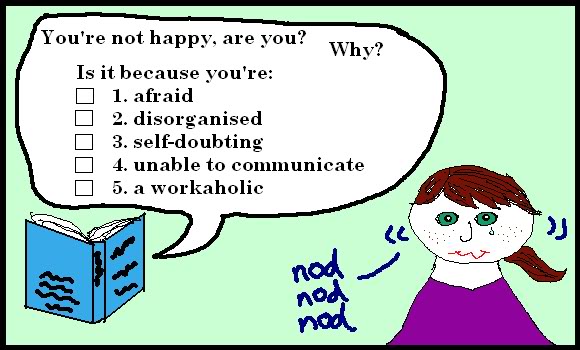
If you remember my Actions for January, I decided to read a book on procrastination. Ironically I not only got around to doing it, but I read two! I'm glad I did, because the approaches they used were so different, I was amazed. I thought I'd do something a bit different, and review them in picture form. I used Boy's graphics tablet for the illustrations.

The first book I read was Eat That Frog! : 21 great ways to stop procrastinating and get more done in less time / by Brian Tracy, a motivational writer and speaker.


That's pretty much it. The book focuses almost wholly on procrastination in the workplace. In the Introduction, Tracy explains that he's not going to go into the complex details of why people procrastinate, but concentrate on strategies to stop procrastinating. This assumes a frame of mind for the reader that hasn't necessarily been achieved yet. I certainly haven't. Besides, I'm not really interested in making more money and having a fancier car. In conclusion, I don't think this book is really for me.


The second book I read was The procrastinator's guide to getting things done / by Monica Romirez Basco. This approaches the topic from a completely different viewpoint. Basco is a psychologist specialising in cognitive behavioural therapy. So, unlike Eat That Frog, this book is all about why people procrastinate.


Basco covers procrastination in all areas of life and for many reasons. The Support Group members in the book struggle with everything from delaying telling a grandmother about a divorce because of the possibility that she won't approve, to not doing housework because watching DVDs is more fun. The focus is on making progress in small steps and thinking about why you're doing what you're doing - or not doing! There are exercises and tips for dealing with procrastination in a wide variety of situations. The "On A Personal Note" sections, where the author writes about her own experiences with procrastination, add a friendly, reassuring touch. In the final chapter, the Support Group members all make at least some progress, leaving the reader with an feeling of optimism. For anyone who is truly willing to change and is ready to examine their issues and mental processes, this book will prove very valuable.

Wednesday, 12 January 2011

A Trip to the Libary : The Big Ass Book of Crafts


Click on image to view at Book Depository. (This is just a normal link!)

I received The Big-Ass Book of Crafts for Christmas from the Lovely Boy, and I've just finished 'reading' it. The author Mark Montano is apparently a TV personality in the U.S., presenting shows on interior decorating. Most of the projects in this book reflect this angle. I do like his style - quirky and colourful with Mexican influences. There's not much beige to be seen in this book!

The projects are arranged into chapters by either type of item (e.g. tableware, paper goods) or material used (e.g. felt). Some are made from scratch. Many take finished items such as a table or a photo frame, and jazz them up. Others take a household item and turn it into something else - wine glasses into candle-holders, for example. With this kind of craft, there is the potential for hits and misses. The mirror-encrusted table top is beautifully elegant, but the drinking straw lampshade looks like something I would have made in primary school. Which is fine if you're crafting with small children, really! The huge range of projects mean there is something for everyone.

There really are a huge number of projects in this book! In some cases I wonder if quantity was chosen over quality. Most of the instructions are written only - there is a photo of the finished product but nothing else. For the simpler projects, this is fine. Take A and glue to B. Easy! For the more complicated projects with many steps, it could be an issue. I'm less likely to start a project if I feel I have to nut out how to do it as I go along.

There are advantages to having such a huge choice of projects, though. There are some that I can't do because I don't have power tools. On the other hand, there are plenty that I can do because I have a sewing machine and an Op Shop just down the road. Don't like the tray-table project? That's okay, there are 4 in different styles that you might like. I noticed that some disparate items are made using the same technique, for example a basket and a photo frame both made from ice cream sticks. Some may call this repetitive, but I think it's a good idea as it encourages the crafter to think of new ways of applying known techniques.

Unfortunately The Big-Ass Book of Crafts suffers from a couple of annoyances. The crafter is advised to search for colour pictures online or order from certain websites to obtain some of the supplies. What if you don't have a computer with a colour printer? What if the online shop doesn't deliver to where you are? What if you're not able to drop into your local 'Staples'? (I've never even heard of Staples, I'm guessing it's like Officeworks? If so, I wouldn't poke 'em with a ten-foot pole!)

There's also an issue with the glue-non-specificity that I've complained about before. I can probably figure out a substitute for 'Elmer's Wood Glue' and 'E6000', but what the heck is 'Goop'? Or 'Krylon'? Where would I find a substitute for these in Australia? There's some consolation in knowing there is a list of suppliers' websites in the back. I'll just have to do a bit of research and hunt around in my local hardware shop.

The overall style of the book is contemporary with a dash of Mexican folk, and written in a chatty yet not over-the-top style which I like. Considering that I'm about to be handed the clean slate that moving house provides, I can see myself referring to it frequently in the near future.

Monday, 18 October 2010

Books Are People


From WeHeartIt
Or at least, they have many of the same characteristics.
Because I welcomed 8 new books into my life on the weekend, I decided that today my Declaration of De-Cluttering would focus on books. Of course, you would never just throw a book in the bin. That would be even worse than, say, covering it with paint and sticking bits of paper all over it. Ahem. Or ripping pages out of it and sticking them in your art journal. A-HEM!

No, I don't plan on doing anything that drastic, don't worry! I either give my books away to the Salvos or I put them in the Information Centre's book swap stand at work. I have an especially hard time letting books go. It's very rare that I would get rid of a non-fiction book - I might need the information again one day. And with novels, there might just be a chance that I want to read it again. About 5 years ago, I joined BookCrossing. It's that thing where you leave books in random spots for other people to find and read and pass on themselves. I released a few books myself, but I missed them too much and wished I'd kept them. A Wizard of Earthsea - that was a really good book. I wish I'd been able to re-read it before I saw the movie. It was a really old copy that smelled good, too. And Music and Silence by Rose Tremain. I might have read that again. Later I found out it was nominated for a Whitbread Award. I would definitely have kept it if I'd known that.

*sighs*

This morning before work I thought I'd choose a book to give to the Information Centre book swap (I actually owe them 3). I stood in front of (one of) my bookcase(s) trying to decide for about 5 minutes before abandoning the whole undertaking. I chose the wrong bookcase, obviously. Perhaps I'll throw away something easier today. It's only Day 3, after all.

There's one book though, that my mind keeps spiralling back to. I have a bit of a dilemma surrounding this book. I won't tell you what it's called - that would be a bit mean. You'll see what I'm talking about. This book was sent to me for free on the proviso that I post a review of it on LibraryThing. This is easier said than done. I received the book nearly a year ago, and I haven't been able to get past Chapter 3. It's a junior book in the vein of Harry Potter, mixed with some Alice in Wonderland. Sounds easy, right? Well, every time I open it up, I feel like my brain is melting and sliding out through my ears. The plot is derivative and stale. The characters are lifeless. The storyline plods heavily along. There are enough typos and grammar errors to give me an aneurysm. I don't think they even used spell-check. I'm serious. And the writing style ... imagine you're walking down the street and every two steps you stub your toe on a broken piece of footpath. That's what reading this book is like.

It's quite obvious that the publishers of this book were fishing for some good reviews by readers grateful to receive a free copy. But I don't even want to finish it, let alone review it! The whole thing is made even yuckier by the fact that there's a positive review of the book on LibraryThing already - written by it's author. That's just trashy.

Of course, you would never just throw a book in the bin, right? But the thought of a young child reading this book when they could be reading Ursula le Guin, Philip Pullman or even J. K. Rowling, sends cold shivers down my spine.

I don't know what to do!

Thursday, 1 April 2010

A Trip to the Library, Part 2

The next book I borrowed was A Guide to Making Decorated Papers by Anne Chambers.


Sorry, this was the best picture of the cover I could find.

Published in 1989, it's quite an old book, but still contains much valuable information. The history in the introduction was short but interesting. Of the 9 techniques, the ones I found most inspiring were paste papers, orizomegami and suminogashi. Paste paper involves cooking up a flour and water paste and adding colouring. Then you spread a layer of paste on your target paper and mark it using various methods. Once dry, areas of light and dark shading are created. This technique was quite exciting, because it's so easy and, with almost endless variations available, you can make a paper that looks funky and modern, or baroque and intricate.


paste paper - raspbery & blue, originally uploaded by lubsy1uk.

Orizomegami involves taking rice paper or another absorbent paper, accordion-folding it, and then dipping the corners in dye. I have seen this technique before recently, but using paper towels and not acknowledging its Japanese origin. I was a bit iffy on it then, but Anne Chambers' explanation of the process and her use of a more substantial paper was a lot more interesting to me. The illustrations showed some beautiful results, reminiscent of stained-glass windows.

Suminogashi is a close cousin of the more well-known marbling technique that uses oil paints swirled on a turpentine bath. This technique however, uses writing ink and water, which is much less messy and toxic. The result is a light, delicate marbling effect with a lot less effort than you would have thought.

I will be trying all of these techniques in the near future. Another interesting section was on rubber stamping - a concept that's pretty straightforward, but Chambers demonstrated some shapes and configurations that I hadn't thought of before. Using rubber stamping in combination with the paste paper decoration seemed particularly intriguing. I'm definitely glad I borrowed this book!

In other news, I'm going away on a mini-holiday for Easter! It's fast turning into a tradition that Boy and I go somewhere with lots of food and wine at Easter. Cos that's what it's all about, right? This year, it's the Mornington Peninsula:


ashcombe-maze, originally uploaded by thealexandertoddwilliams.

There's hedge mazes, too!

Saturday, 27 March 2010

A Trip to the Library, Part 1

I think I'd like to talk about some art & craft books I borrowed from the library over the last few months. Firstly, I borrowed The Complete Guide to Altered Imagery by Karen Michel.


I'd heard quite a bit about this book from other journal artists, and I have to say, I was a bit disappointed. Perhaps it was just because most of the techniques didn't fire anything up in me. Maybe it was because some of the materials are quite hard to come by. Perhaps it was because I don't like the author's style of art - which is completely a personal thing and has nothing to do with the content of the book. I put it aside for a couple of weeks, and when I picked it up again, I started to see it in a different light. I started thinking about which techniques were more 'me', and how I could apply them to my art journal.

The first section deals with altering photographs. There is some amazing stuff to be done with rubbing, scratching, colouring and bleaching original photographs. Unfortunately they're a lot harder to come by than they used to be, especially since the Polaroid camera was discontinued. All of my photos these days are taken with a digital camera and then printed out with my mini photo printer (I love it! <3 ) However, Boy has informed me that techniques involving chemically altering the image emulsion are not going to work with photos printed in this way, which was a bit disappointing. The last part of this section has some interesting examples of how to incorporate the altered photographs into a collaged and painted artwork.

The second section looks at altering images digitally using photo-editing software. It has some interesting techniques, some of which I hadn't thought of before. It doesn't go into the nitty-gritty of how to use particular programmes - there are so many out there, it would just be impossible. There's some food for thought here, though.

The third section covers altering found images (from magazines, etc) and incorporating them into artworks. I've seen all of these techniques before in collage books dating back to the 1970s, but it's nice to see them presented in a new way - and in colour!

The fourth and last section is a gallery of pieces by artists working in the altered and/or mixed media genre. Some of these got me really excited. I started to think about which particular artists, both in this book and online, I like the most. And looking at their styles got me thinking about what my style might be when it eventually emerges. I haven't come to any firm conclusions yet, but there are certain techniques and juxtapositions of elements that I seem to be using more than others. I'll do some scans soon and show you what I mean. I know I've only just scratched the surface when it comes to using different materials and techniques, and I know I'm a long way off from being able to define my style, but I feel I'm inching closer and closer.

In other news, I've been writing away furiously at my new zine - and I've started a second one! Busy busy writing time.

Have a great weekend!

Monday, 14 September 2009

Book Review: Jane Austen's Sewing Box


Jane Austen's Sewing Box explores the Regency Period crafts mentioned in the novels of Jane Austen. Craft work was integral to women's lives at the time, and so is referred to frequently in all of her writing. A knowledgeable yet entertaining introduction explains the perception of women and their role in society of the time. The sewing of clothes and manchester for themselves, male relatives and impoverished neighbours was known as 'women's work', and every respectable woman was to be seen with a work basket prominently placed in the home. 'Fancy work', as decorative embroidery was then known, was an acceptable activity to perform in front of guests, and allowed a woman to show off her skill and wealth - having the leisure time to work on unnecessary items was a sign of status in society. There is also a section on materials used at the time and how they were made, which is indispensable for anyone wishing to make truly authentic period pieces.

There are 18 projects, covering sewing, knitting, netting, glass painting, and papercraft, all of which are based on actual craft projects or handmade items mentioned in Jane Austen's novels. An introduction to each one, with quotes from Austen's writing, explains the item's context in womens' daily life. The projects are rated Beginner, Intermediate and Advanced, and those that contain mixed crafts (e.g. sewing and embroidery) are specified. Some projects, such as the Cravat or Muff, are not very practical and would appeal more to an enthusiast of the period. Others, like the Embroidered Work Bag or the Huswife (a pouch for keeping sewing tools in) would be very handy even today.

The first thing that struck me about this book was how beautifully designed it was. Period wallpaper and fabric designs border every page. The liberal full-page close-up photographs of furniture details and luscious coloured fashion plates could be construed as filler, but to me it had the effect of immersing me in the aesthetic of the time.


The second thing that struck me was the vagueness of the instructions. They're accompanied by hand-drawn diagrams, but not every step is illustrated. There are very few templates; instead we are told to cut a rectangle with an oval at the top 10cm high, for example. Personally, if I had to hand-draw that myself, it would look rather wonky. Some of the embroidery patterns require enlarging on a photocopier, whereas they would have easily fitted into the book at life size. To me, this detracts from the authentic historical feel of the creative process.

Despite the fact that some projects are labelled Beginner, I would not feel confident at all following the instructions if I had never tried that craft before. I have never done netting for example, and even though there are diagrams, I found myself at a loss. Perhaps it's a case where it would all fit together once I started, but I don't like working that way. By and large, the finished projects are photographed with either artistic blurring or from an odd angle or both, which make them of no use for the struggling crafter needing a visual reference. There are also a few errors - in Paper Flowers, for example, the materials list includes ribbon, which is not actually used in the construction.


Regardless of these flaws, I found Jane Austen's Sewing Box a delight. The mixture of history lesson and literature appreciation is highly readable, and I'm very enthusiastic about trying some of the projects, even if they do need a bit of nutting out. The Carpetwork Cushion (aka Tapestry work or Needlepoint) caught my eye in particular, and I think I need about 10 Huswives. I have a sudden urge for everything in my life to be floral.

I wonder what Boy thinks of that?