Showing posts with label inspiration. Show all posts

Monday, 29 April 2019

Art and Loss

Today's post is a bit more personal than normal, and it's been hard to write, but I feel it's important.

My job finished up just before Easter, and since then I've been working on my art project. I was excited to have unlimited time to work on it, and was feeling confident that I'd finish on time and everything would go swimmingly. I was having ideas for new pieces and tucked them away in my brain for later. I even started on one, but just a little bit here and there, knowing I'd have plenty of time later.

Then I got some news that changed everything. An artist that I admired and knew a little had died. She was only a few years older than me and her name was Natalie Uhing. Her art was exuberant, playful and colourful with a dark twist. You can see much of it on her Instagram here. I had been following her long enough to see the changes in her style and influences. When she started a mail art subscription just over a year ago, sending a beautifully decorated letter once a month, I signed up straight away. Each letter told a story from her life, of travel and adventures and encounters with people, all written in the most beautiful calligraphic hand. I feel lucky to have every letter she produced.


Even though I felt I came to know Nat through her letters, as I mentioned, I only knew her slightly. I never met her "in real life", only exchanging a few messages through Instagram and Patreon. It's hard to describe a friendship with someone you've never met. The internet hasn't been around long enough for there to be words for that. Even still, acquaintance is probably the best word. She did mention once that she'd never been to Melbourne, and if she did visit one day, it would be great to meet up. I was excited at the prospect, but it will never happen now.

I don't mean for this blog post to be depressing or to garner pity. Nat was a happy, curious, passionate person from all accounts, and that's what should be remembered about her. Her art will continue to inspire me, even though the person who created it is gone. It's also driven home to me that we don't have unlimited time left. Even if I'm only half-way through my life, that's still not very long.


Since hearing of Nat's death, I've had a great sense of what the Germans call torschlusspanik. Literally meaning "gate-closing panic", it's come to signify the fear that life is passing you by. If you don't act now to do the things you want to do, you might never get the chance. None of the doubts and insecurities I have about my art and writing seem to matter anymore in the face of this feeling. Of course, I still have my anxieties, and I still let them hold me back -- it's only been a few weeks, after all, to get used to this new way of living -- but I try to overcome them and create anyway. There's no better way to say it than Nat did herself on the tagline of her blog:


Express yourself. It is later than you think.


Tuesday, 9 January 2018

National Gallery of Victoria Triennial

Last week I went to the National Gallery of Victoria's first ever Triennial. The Gallery plans to hold the exhibition every three years, in Summer. The first Triennial features 100 artists from around the world, but especially focusing on the Asia-Pacific region. Various types of arts are represented, from traditional painting and sculpture, through to conceptual art, architecture, and furniture design. The exhibits filled up the ground floor, and were scattered amongst the usual displays throughout the upper levels.

One of my favourites was by Yayoi Kusama. An entire apartment re-created in the gallery, with every item you could think of. All surfaces were covered in red flowers. Each visitor was given a fabric flower of their own to stick whereever they liked. The effect on everyone who entered was magical.


Not far from Kusama's apartment was an installation by We Make Carpets. This colourful wall was made entirely of ordinary kitchen sponges!


Other displays invited visitor participation. Pool noodles cut into different lengths could be fitted onto pegs to create a pattern. This room was a lot of fun!


There was a room full of these stunning mask-like creations. They looked like glass, but they were actually 3D-printed. By Neri Oxman.


This pop-art styled room was filled with coloured strings strung from floor to ceiling. Moving through it gave an illusion that the strings were moving.


Of the paintings, I found the series by Kushana Bush intriguing. She mixes the flattened style of traditional Indian and Japanese art with Western subject matter and composition.


This gorgeous carpet uses colour and texture to paint a landscape. Visitors were allowed to lie on it, as long as they didn't get their shoes on it ... which the poor guard had to repeat at least twice a minute!


Normally, works with a political or issue-based message don't have that much effect on me, but I was strangely moved by this piece by Shilpa Gupta, which addresses the ongoing effects of colonialism in India. The huge, room-filling, amorphous sculpture is made of microphones. From it emits the sounds of a streetscape and a voice speaking of an imaginary world with no borders. I found the contrast between the microphones, which are meant to take in sound, and the sound being emitted by the piece to be strangely otherworldly.


I liked this carpet by Faig Ahmed, which makes a statement on our perceptions of tradition.


Most of all, I like art which is a joyous celebration of life, which I think these weavings by the artists of the Akay Koo’oila Women’s Art Centre exemplify.


Last but not least, one of the most popular works was this skull room by Ron Mueck. 100 giant-sized skulls are stacked up all over an entire room of the gallery.


The Triennial is open every day until 15th April 2018. Admission is free.

Thursday, 20 July 2017

Craft Is Important

Last year I wrote a post called Art Is Important. Of course, I believe that craft is important too, but I've suddenly realised that I'd lost sight of that in the last couple of years. I'd forgotten how important craft is in my life, and in society. I'd convinced myself that it doesn't matter if I use a five-dollar blanket from the supermarket instead of one I crocheted myself. That it's okay to settle for plastic coathangers in my wardrobe instead of ones with colourful knitted covers. That my clothes are so cheap and unloved, there's no point in embroidering them. I let impulse-bought junk pile up on my sewing table until it was unusable. I'd found myself saying things to my friends like, "oh, I'm too impatient to finish anything anymore." And I'd succumbed to the voices in my head that told me I can never make anything as nice as the things I see on the internet, so why bother even trying?


I tried to snap out of it with different plans and systems, creating elaborate spreadsheets with colour-coded sections and spending hours checking and tweaking them. I tried re-organising my projects to make it easier to access them. Nothing quite seemed to work. It would take more than a spreadsheet or fancy storage basket to change my mindset.


Slowly, a combination of influences has built up to create a change, though. Throughout this year I've been reading about fabric dyeing and embroidery on Rhiannon's blog, as well as many more talented crafters. I've had reason to go through my old blog posts from 10-12 years ago recently, and found myself thinking, "wow, I used to make so many good things!" Mentioning to my friend last week that "I don't finish anything anymore" was more than a little saddening, when I reflected on it. The "final straw" came a few days ago when I read a blog post by Bjørn Bull-Hansen: Your Viking Hands. He writes about the importance of knowing how to do and make things with your hands.


I daydream about leading a traditional lifestyle and enjoy reading about people who embody them. Bjørn's post is about Viking crafts, but it got me thinking about traditional crafts in general. I have a bit of a survivalist streak in me (more so recently), and I often think about things like permaculture, bartering, and local currencies. I realised that I haven't learned many of the traditional crafts that were vital to societies in the past, such as spinning, weaving and woodworking. I'm very glad I know how to knit, but I'd also like to learn crafts such as nalbinding, repairing clothes and bushcraft. I haven't even gotten around to learning how to light a fire yet! (Sure, I've been Bear Grylls do it on TV, but watching is very different to doing.)


Now I'm looking through the List of Handicrafts on Wikipedia for more inspiration. I did a ceramics class many years ago, and it would be nice to do some more, if I can get access to the equipment. I learned felting when I was a kid and the process is easy enough to remember, so I've got that covered. Basketmaking, bookbinding, tablet weaving and lucet cording look very interesting. Then there's the whole world of Japanese Crafts.
(I'm sticking to practical crafts in my thinking right now, not decorative ones.)

I got so excited that yesterday I ordered a drop spindle from Etsy. It's something I've been meaning to do for a long time, but if I don't do and learn things now, then when will I ever do them? In a world where it's so easy to spend a few dollars on something made thousands of kilometres away in near-slavery conditions, I believe we need to stand up and say, no, there's a better way. I want to be useful to society, not just for my ability to sit in a chair all day and check 10,000 lines on a spreadsheet, but for making practical things with my hands that will improve the lives of those around me.

Thursday, 29 June 2017

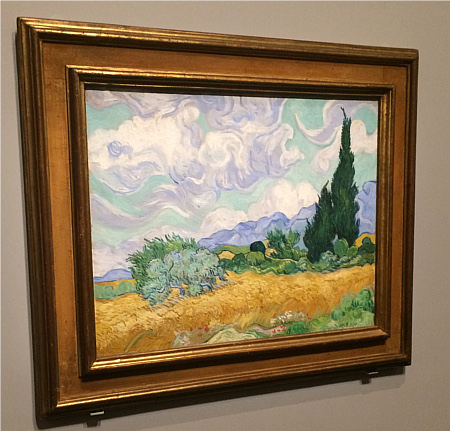
Exhibition : Van Gogh and the Seasons


A few weeks ago I went to see Van Gogh and the Seasons at the National Gallery of Victoria. It was a typical Winter day in Melbourne: sunny and clear but cold. There was a lot of excitement surrounding this exhibition, as it's the first time that many of the paintings have travelled outside Europe. I have to give credit to the NGV for securing agreements like this one in the last few years. It allows us on the far side of the world to see influential works of art without having to travel the long distances we would normally.


But back to the exhibition. I went with Husband and my Mum. She made a special trip down from the country and spent the weekend at our house in order to see the exhibition, so I was hoping it would be good! We purchased tickets online beforehand and I was very glad I did, as there was a long queue to purchase tickets, and a second, even longer queue to get in for people who already had tickets. Thankfully it moved quite quickly though.

The first room we encountered was a cinema showing a short movie of Vincent Van Gogh's life. I was looking forward to this as I'd heard it was narrated by David Stratton (a famous Australian movie critic) with the actor David Wenham as the voice of Van Gogh. I was too impatient to stay until the end though, I have to admit. Next, we had to negotiate a corridor with textual displays of biography and quotes which felt a bit like a laboratory maze, before we could enter the first room. It was rather slow going as we had to wait for space to free up in front of us each step of the way.

As is usually the case, the rooms were overcrowded and there was a wait to see each artwork. (Unless you wanted to see it like this:)


The first gallery contained prints of 19th-century European paintings and illustrations that had influenced Van Gogh, and the second Japanese prints. While these were interesting, it wasn't clear at first that these works weren't actually by Van Gogh himself without reading the information cards. In the end I bypassed them, as the wait to see them up close was so long and I believe most of them were from the NGV's collection so I could see them another time.


Finally, we reached the main event. Unlike most exhibitions I've been to, the artworks were arranged not chronologically, but by season, starting with Autumn. I found this very appealing as someone who has always been attuned with nature and the seasons. Van Gogh's emotions were always affected by the seasons, and he let this show in his work -- from the melancholic greys and browns of Winter, to the bright, joyful blues and yellows of Summer. Despite the distractions of tour groups, selfie-takers and pushy children, I found myself becoming entranced by this progression of the seasons. As we moved into Winter with its stark, bare branches, I started to feel melancholic myself, and longed for the lighter colours and blossoms of Spring. While a little incongruous with the Australian Winter outside, I'm glad the exhibition ended with Summer -- it would have been too depressing otherwise.


The final work was a self-portait, one of many that Van Gogh painted, but the only time his face is seen in the exhibition. Because of this perhaps, I found it especially poignant. Painted only a few months before his suicide, the sharp strokes of pink, yellow and blue paint seem to reflect a mind in turmoil.


Providing an almost absurd contrast, to exit I had to step over some children sitting in the doorway doing their Van Gogh colouring-in books, and found myself, of course, in the gift shop. (Those of us who know the work of Bansky like to think we do that ironically but in reality it's more like helplessly.) I came away with a catalogue, a fridge magnet and some postcards for my inspo wall.


While some of Van Gogh's iconic paintings were notably absent (Starry Night and Irises come to mind), I found the selection of works from throughout his career to be representative and satisfying. I'm certainly glad I went. While it was a struggle to deal with the crowds, it shows how much the artist's vision is valued today. Van Gogh died unrecognised and penniless. Not long before his suicide, his brother Theo wrote to him: "in the course of time they will become more beautiful and they will undoubtedly be appreciated some day."(1) I'm sure both brothers would be astounded and very pleased by how much Vincent's work is loved today.

Monday, 30 January 2017

I Want to Make a Temperature Scarf

Since the start of the year I have been following Jillian of One Pink Hippo as she makes a Temperature Blanket. I'm feeling inspired to try something similar! The weather in Melbourne is so changeable that I'm sure the result would be very interesting. A blanket is a bit too much of a commitment for me at the moment: I really can't see myself crocheting/knitting a whole row every day. It's also a financial commitment to purchase enough yarn in enough different colours. A scarf seems much more manageable. I've been doing some research to work out the details.

Jillian's hexie blanket, about 2 weeks in. Picture Source

A Temperature Scarf/Blanket/etc is a conceptual project -- different colours are assigned to temperature ranges in your local area (e.g. on a 11-15 degree day, you might knit a light blue row; on a 6-10 degree day, a dark blue row). At the end of a year, you'll have a record of the daily temperature in crafty form. The project can take any form you like, any pattern, any combination of colours. There are so many ways of going about this project that it's a bit daunting! Jillian's method of making a hexagon-shaped granny square every day is cute and wouldn't take too much work, but on the downside, there will be a lot of ends to weave in, and she has to make adjustments to plan for the fact that 365 squares won't fit neatly into a square afghan.


A straight granny stitch afghan. Picture Source
I had the idea of making 12 granny squares, one for each month, and a row for each day. That would make a nice blanket size/shape, and you could start the next month before finishing the previous one if you fall behind. However the downsides of that are: having to adjust for shorter/longer months to make the squares the same size; having increasingly long rounds to crochet by the end of each month; possibly many ends to weave in; not telling the 'temperature story' in a flowing way.

A finished blanket embroidered with the year. Picture Source

Several others that I've seen made scarves using double/circular knitting, which I've done before in making the Harry Potter scarf. I'm really drawn to this idea, as there isn't too much knitting to have to do each day, I know it makes a nice smooshy scarf, and -- the BIG upside -- there's no weaving in. You can just knot the ends and hide them on the inside of the tube. The downside is that there's a visible jog in colour changes with this type of continuous knitting, but that can be hidden a bit on the edge of the scarf.

A circular-knitted Temperature Scarf in progress. Picture Source
I also saw various other cute ideas such as: making the width the same number of stitches as the person's age; adding in a metallic thread on snowy days or important dates; making the stitches taller or narrower as the days grew longer or shorter; adding in a second narrower row between each main one to record the minimum temperature as well as the maximum.

I adore the colours in this finished scarf. Picture Source
Of course, 1st January has well passed, but I feel like it would be more appropriate to start the scarf in Autumn, rather than the middle of Summer. So I'll wait until 1st March. That will give me a month to go through my stash and purchase any colours that I need, as well as think a little more about taking on a year-long commitment like this.

Sunday, 2 October 2016

My September

It's Spring here in the southern half of the world. The days are longer, the trees are waking up, and the cat spends his mornings lazing in the sun. It's taken a while for the weather to warm up -- even now there are just as many cold and rainy days as Spring-like ones. As inspiring as Spring is, I'm not one to love the Summer heat, so I'm enjoying the cooler days while I can. I've been working on lots of creative activities, though not being able to focus on any one thing on particular, so I feel like I haven't made much progress.

This coming month is Inktober, and also the next round of Creative Sprint. I know many people love Inktober and I'm looking forward to seeing their work, but I have decided to participate in Creative Sprint. Because of my dilemma above, and the ridiculously long list of WIPs I have at the moment, I have decided to focus on working on current projects of all types. I will try to post my progress on my Instagram every day, and also weekly updates here on the blog. But now, back to what I did in September...

What I've been painting ...
There are so many interesting e-courses out there, many free, that it could take me a lifetime to get through them all. I finished the Fluent Self Journalling course, and began Tara Leaver's 10 Days to Making Art You Love course. The first assignment is to do a very simple, quick landscape in any medium you like. I've been very inspired by dreams lately, so I did this dreamlike scape, like something from a primitive myth or an alien world.


What I've been visiting ...
During the month I was very busy with events. Well, one event per week is 'busy' for me, I have to admit! I went out of my anxiety comfort zone and went alone to the Bad Girls' Club exhibition, at a pub in the trendy part of town. There was so much amazing, feminist work there, and I met up with my new friend, one of the artists. I was very inspired and spent all my spare time in the next few weeks writing for my zine, designing plushies, etc.

Bad Girl Zine and bottle shrine work by @possumparcel

What I've been reading ...
I had a renewed interest in reading last month, mostly sticking to the older junior and young adult books that I found while unpacking. There's a library near my new work, and I've set myself a little challenge of reading and donating 12 books before I join. My favourite, which I remember from my childhood, was Helen Keller's Teacher, about the life of Annie Sullivan, who taught Helen Keller to communicate and was by her side most of her life.


Selections from Instagram
With clearer weather, I've had a chance to go for walks before work in the mornings. After rainy nights, the early morning sunlight has a soft, hazy feel to it, and even in the city there are some beautiful shots to be had -- especially when water is involved. It seems I've had a fascination with reflections lately.


The Native Mint plant in my garden. It smells divine, but I haven't yet been able to find out if it's edible:


Friday, 29 January 2016

My trip to the Countryside

Yesterday I went on a little outing to Castlemaine. Regional public transport is free of charge all of this week, an offering that was apparently made because of a recent series of issues in the transport network. Seeing as I have some free time on my hands at the moment, I decided to go on a little day trip to a country town. I chose Castlemaine because it has several attractions within walking distance of the train station, plus it's known for its heritage buildings.


This was in some ways a big step for me. In the last few years, my anxiety has gotten worse, and I've let it get the best of me much of the time. It's made me reluctant to go to social occasions or go anywhere on my own. I nearly changed my mind about going several times in the week beforehand, imagining all the terrible things that could have happened. But in reality, the "worst" thing that happened was I didn't have time to see everything I wanted to see! Going on an adventure like this was a huge boost to my confidence.

The train left Southern Cross Station from platform 16, at the opposite end from where the regional trains normally leave from. After wandering around for a while, I caved in and asked an attendant. I'm glad I did, or I would never have found it!


The trip to Castlemaine takes about 1-1/2 hours. The landscape gave way from urban wasteland, to farmland, and eventually to bush.


I arrived at the replica 'historic' station at about 10.45.


The weather was overcast and extremely humid the whole day, but at least not too hot. I found the art gallery without any issues thanks to the maps on my spiffy new ipad.


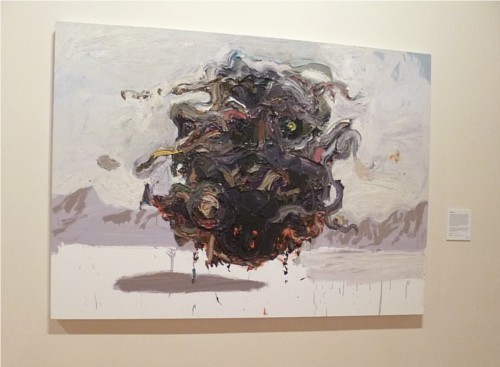
The art gallery is quite small comparatively, but it had some beautiful pieces. The feature exhibition was by the war artist Ben Quilty.


There was also a room of 19th- and 20th-century Australian art with some beautiful portraits.


When I first entered, the lady behind the front desk mentioned that there was a museum downstairs. I'm so glad she told me because there were no signs and I certainly wouldn't have found it otherwise. It was an amazing space, packed full of treasures telling the story of the local area. While the art gallery up above had quite a few patrons while I was there, there was no-one else in the museum at all, which was quite sad, but it gave me a chance to have a good look at everything and take some sneaky photos.


While I was there, a lady came in and started chatting to me. She was the curator of the museum! She told me all about the silver collection of over 250 pieces, and the arts and crafts that had been created by former residents of the town. She told me that if I was interested in that sort of thing (yes!!) I should visit Buda, a historic house nearby. I had been planning to go to the Botanic Gardens, but listening to the history of the home's inhabitants convinced me that I definitely wanted to go. I asked her for directions, which she was of course very pleased to give me.

On the way to find Buda house, I stopped off at a 'hole-in-the-wall' place to buy a coffee. I asked the lovely gentleman if he had any gluten-free snacks. He didn't have any left, but he was so lovely about it, and mentioned that they had gluten-free options for their lunch service, that I determined to go back there for lunch. After drinking my coffee and contemplating life for a bit, I walked on to find Buda house. It's on the edge of town, up and down several steep hills. I have to admit, a couple of times I thought to myself, where the heck am I?


I eventually found it and went in. It was fascinating. The house had been built prior to 1860 in the style of the time, with small rooms dimly lit with small windows. Then in the early 1900s, an extension had been built on to provide a sitting room, music room and gallery. The contrast between the old part of the house and the new is striking -- the new rooms being much larger, with large windows giving an airy feel.


The history of the Leviny family was fascinating as well. The mother and father had 8 children. Only three married; the other five (all girls) lived in the house for the majority of their long lives. Thanks to their father's inheritance, they were able to pursue their love of arts and crafts, everything from photography to metalwork. I have to admit, I wasn't a little envious on hearing that! Many of their personal belongings, as well as their artworks, were on display in the house. It really gave a personal touch and I found it quite moving.


The extensive garden was wonderful as well. There was a pond, herb gardens, a cypress hedge, and some amazing pine trees. At first I thought this beauty was a Monkey Puzzle Tree!, but on googling it I found out it's actually a Bunya Pine. Still gorgeous though!


The garden had an interesting mix of 'traditional' style plants, and cacti and succulents.


After the excitement of the garden, I was starting to get hungry. I walked back into town and found the Good Table again. With help from another lovely waiter, I selected the pork with polenta, and strawberry semifreddo for dessert. I had a Pimms fruit cup as a treat. I love some irony with my food!


The food was excellent, if overpriced. I do want to go back with a bigger group though, so I can sit at the table with the chicken centrepiece!


It was time to go home, so I headed back to the train station. I had half an hour to wait (country trains!) so I wandered around for a bit and saw what is presumably the original train station.


I was planning to read on the way home, but I did some more thinking and ended up having a nap.

It was a really lovely day, and I'm proud of myself for engaging with other people, following my instincts, and being open to new possibilities.